 Arthya
How to read your card’s benefits and the MITC before you swipe
20 October 2026
Every card comes with two kinds of paper, even when both are PDFs. The benefits list covers lounges, fuel, dining, points, and milestones. The Most Important Terms and Conditions, the MITC, covers what the credit costs and what you and the issuer owe each other. Reading only the friendly list leaves the price invisible. This is a way to read both once, before a large payment. The sheet with your name on it is the one that applies.
What the MITC is for
The Reserve Bank of India requires issuers to give you that term sheet. For commercial banks, the current text is the Reserve Bank of India (Commercial Banks – Credit Cards and Debit Cards: Issuance and Conduct) Directions, 2025, updated as on 1 October 2026. Open it if a summary and your issuer’s sheet seem to disagree. The directions are updated, so use the RBI copy.
The sheet covers fees (joining, annual, cash advance, service charges, the interest-free period with examples, finance charges, and default charges), your limits, and billing: how the statement arrives, the minimum payable, how to pay, how to dispute a charge, and how to reach the issuer. It also covers default, closure, loss or misuse, complaints, and what may be shared about you.
You are meant to see the fees when the card is marketed, a shorter key-fact statement when you apply, the full sheet in the welcome kit, fee and billing items on statements, and a notice when terms change. You do not have to memorise the list. You do need to know where your copy is.
Where to find your copy
Look in the welcome email, the card section of the app, and the issuer’s site, usually under fees or “most important terms”. The benefits file is often separate. Download both and note the date on each. A page from the month you applied can be a year behind the page that applies today. If you cannot find the MITC, ask for it in the app before you trust a rewards banner.
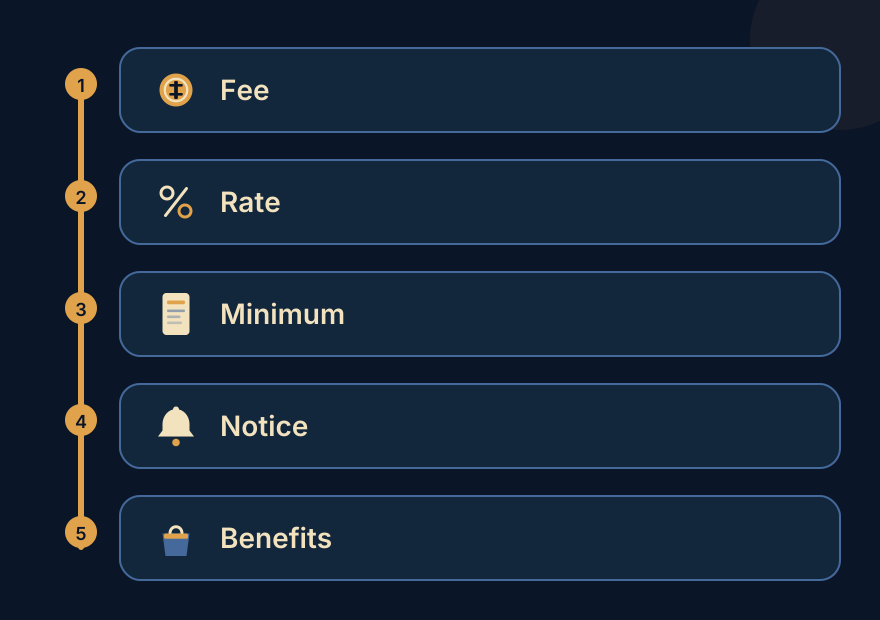
A reading order for one sitting
Start with the fee and the interest-free period. Write the annual fee, and any waiver condition, in the issuer’s words. Then read the illustration of the interest-free days. A purchase just after a statement and a purchase just before one are not treated the same. The directions say the MITC must explain that this period is suspended if any balance from the previous month’s bill is still outstanding. One unpaid statement changes the cost of every new purchase. Find that sentence on the page.
Next, find the finance charges and the annualised percentage rate. Issuers have to quote that rate where it differs, for example between shop purchases and cash advances, and show the workings with examples. The rate and the annual fee are to appear with equal prominence, including in the welcome kit and on statements. Put a bill you might carry into their example.
Then read the minimum amount due and the warning beside it. Statements must caution you that paying only the minimum can stretch repayment over months or years, with compounded interest on the balance. The minimum keeps the account from being treated as unpaid. Paying the bill is a different act. The directions also say the terms, including the minimum, must be set so unpaid interest and charges are not quietly piled back onto what you owe. Clearing the statement is still what keeps the interest-free period.
Read cash advances on their own. The sheet lists a fee and a finance charge. Do not assume a withdrawal shares the interest-free window of a shop purchase. If the lines are unclear, ask before you use an ATM.
Then read closure while nothing is wrong. A request is to be honoured within seven working days once dues are paid, through more than one channel — helpline, email, phone menu, the website, or the app — and not by post alone. Days spent clearing a bill sit outside those seven. Changes in charges need at least one month’s notice and apply only going forward. If a change disadvantages you, the directions say you may surrender the card without an extra closure charge, once dues are paid. Read that rule in the current PDF when you need it.
Finish with loss and complaints. Save the block-card path in the app, the phone number, and the email. How quickly you report an unauthorised transaction affects liability, which the terms point to. Note the grievance steps before the day you need them.
Read the benefits list second
The benefits list may sound friendly. It is still a set of caps. For each benefit you might use, write who qualifies, what is excluded, the ceiling, and the date you checked. Headlines are easy to remember; ceilings are not. Hidden credit card benefits most people never use walks through lounge access, fuel waivers, purchase protection, EMI, milestones, and dining offers without quoting a bank’s current campaign.
Where a benefit is insurance, the directions say the terms should mention the cover, if any, and when it starts. If the friendly page and the terms disagree, ask the issuer which one applies and keep the reply. Offers expire faster than the MITC, so check the issuer’s page on the day you pay. Choosing among cards is covered in how to pick the right card for each purchase.
A one-page sheet you can use
When you finish, keep a single sheet for each card:
- The card name, and the last four digits.
- The fee, and any waiver condition, in one line.
- The interest-free rule, including what happens if last month is unpaid.
- Where the finance-charge example sits.
- The reward rate you use, and three exclusions.
- Lounge and fuel rules, each in one line, with the date you checked.
- The block-card number, and the path to ask for closure.
Before a large purchase, read the sheet. If it is more than a few months old, open the issuer’s pages again. Terms move. The point of one sitting is to see the price and the cap while the choice is still yours. A blank list of the common categories is what your card actually gives you.
Disclaimer
This article is for general information only. It is not financial, legal, or tax advice, and it is not a recommendation to apply for, keep, or close any card. Card benefits, fees, and terms are set by the issuer and the card network, and they change often. Verify them with your bank, and read your own Most Important Terms and Conditions, before you rely on them. Arthya is not affiliated with or endorsed by any bank or card network. All trademarks belong to their owners.