 Arthya
The UPI merchant charge is waiting until after Diwali
20 October 2026

On 13 October 2026, in Mumbai, the National Payments Corporation of India published a short note. Its UPI and Services Steering Committee had decided that, with the festive season in mind, the merchant discount rate on select person-to-merchant UPI transactions will be implemented immediately after Diwali. The date will be notified separately. The note does not name a calendar day for Diwali. This page will not add one.
That note changes a start date. It does not withdraw the description of the charge. On 15 September 2026 NPCI published a frequently asked questions paper on merchant discount rate for select person-to-merchant UPI transactions. Question 5 of that paper said the framework would take effect on 15 October 2026. The 13 October note replaces that start. The rates and categories below are the ones NPCI has published. Whether they have begun depends on the later notice, not on the September date.
The charge sits with the merchant
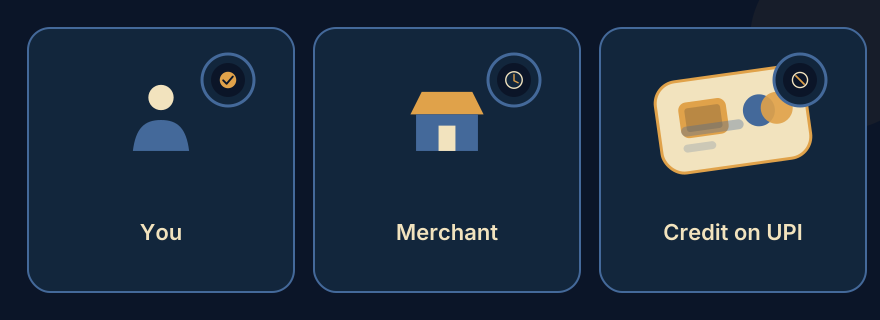
A merchant discount rate is a charge on the business that accepts the payment. It is not a line added to the person who pays. The September FAQ says ordinary consumers will not be charged for making a UPI payment, and that a person-to-person transfer stays free for both sides. That covers money sent to family or friends, and a transfer between your own accounts. The same paper says UPI apps shall not charge a platform fee, or any other charge, on a payment made through UPI. Scanning a QR code stays free for the payer, whatever the amount. Merchants who have been on-boarded cannot pass this merchant discount rate on to the buyer.
Those are rules in the FAQ. They describe the payment itself. They are not a promise that a shop’s listed price will never change for some other reason.
The rates NPCI has already written down
The rate in the FAQ is specific. On a person-to-merchant UPI payment above ₹2,000, the stated charge is 0.4 per cent, paid by the merchant. From ₹75,000 upwards it is capped at ₹300 a transaction. NPCI’s own examples are plain. A payment of ₹2,000 has no charge. ₹3,000 is ₹12. ₹50,000 is ₹200. ₹75,000 and above is ₹300. Payments up to ₹2,000 have no merchant discount rate. The FAQ says those smaller payments are more than 95 per cent of person-to-merchant UPI volume.
Smaller merchants sit in another category. A vendor receiving up to ₹1 lakh a month through a UPI QR code, in what NPCI calls the person-to-person-merchant category, stays at zero. One payment above ₹2,000 does not, by itself, create a charge for that merchant. Acquiring banks watch the monthly total. If UPI credits are above ₹1 lakh a month for three months in a row, the merchant moves to the person-to-merchant category. The FAQ also says GST registration is not what decides the zero rate.
Some industries are on a flat fee instead of 0.4 per cent. For railways, telecom, insurance, and fuel, among others, the FAQ states ₹5 on a transaction above ₹2,000. Insurance premiums and fuel above that line are described the same way. Public utility bills, including electricity, municipal water, and piped natural gas, are also described at a flat ₹5 above ₹2,000, and at zero at or under that line. Capital-market payments, including mutual funds, securities, brokers, and dealers, are set at 0.02 per cent, capped at ₹300.
One line in the FAQ says UPI Autopay mandates do not carry the prescribed merchant discount rate. Another line sets the flat ₹5 for industry categories that include utilities. A payment could be read under both. If you collect or pay one of those bills, use NPCI’s text, not this paragraph, to decide which line applies.
A credit card on UPI is a different product
None of this schedule is a credit-card rule. Question 36 says RuPay credit cards linked to UPI, and pre-sanctioned credit lines, follow separate credit-product rules. The merchant discount rate in the FAQ applies to a payment from a user’s account to a merchant’s account. A credit card on UPI is short-term credit. Its fees, interest, and rewards live in the card agreement.
The screen in a UPI app can make the two look alike. They are not the same product. If you pay a shop from a bank account, the FAQ says you are not charged for the transfer. If you pay the same shop with a credit card inside that app, read the card’s own terms before you assume the reward, or the cost, matches a swipe. A calmer way to choose among rails you already have is in how to pick the right card for each purchase. The policy rate is a separate story, in the repo rate moved on 7 October.
What to do while the date is still open
Treat 15 October 2026 as a date that was published and then deferred. Wait for NPCI’s next notice before you assume the charge has begun. The FAQ itself points people to the Ministry of Finance, the Reserve Bank of India, and NPCI for official updates, and it asks them not to rely on a forwarded message.
If you accept UPI at a shop, the useful check is your category. A small QR merchant under the monthly threshold above is still at zero in the FAQ. A larger merchant can ask the acquiring bank which rate applies to which category, and from which notified date.
If you pay with a card, the 13 October note does not change a reward rate, an annual fee, or the interest on a balance you carry. Those stay on the card’s most important terms. A bank-account UPI payment and a card payment can sit next to each other in one app. Only the account-to-merchant payment is the subject of this charge, and even that one waits until after the festival, on a day NPCI has not yet named.
Disclaimer
This article is for general information only. It is not financial, legal, or tax advice, and it is not a recommendation to apply for, keep, or close any card. Card benefits, fees, and terms are set by the issuer and the card network, and they change often. Verify them with your bank, and read your own Most Important Terms and Conditions, before you rely on them. Arthya is not affiliated with or endorsed by any bank or card network. All trademarks belong to their owners.