 Arthya
From 23 October, the ZET late-payment line is 5 percent, with a floor and a cap
23 October 2026

On 23 October 2026, the key fact statement for the SBM ZET credit card dates two charges to that day. SBM Bank (India) Limited publishes the sheet. One line is the late-payment fee. The other is the cancellation charge. This article reads those lines. It is not a reason to keep the card, or to close it.
The lines below are from the bank’s own PDFs and the Reserve Bank’s directions for commercial banks, as read on 23 October 2026. If a live copy differs, follow that copy, then the statement on your account.
What the late-payment line says
The card on this sheet is tied to a fixed deposit. The credit limit is 90 per cent of the deposit amount. Joining and the annual maintenance fee are both written as zero. The same page says the schedule can change, with notice of at least 30 days. A zero on the joining line is one line. It is not a description of every other charge.
With effect from 23 October 2026, the key fact statement writes the late-payment fee as 5 per cent of the total outstanding due, with a minimum of ₹50 and a maximum of ₹1,000. The secured-card agreement, which includes ZET, uses a shorter phrase for the same date: 5 per cent of the outstanding, minimum ₹50, maximum ₹1,000. That row also still prints ₹299 above the dated line.
The key fact statement says goods and services tax applies to fees, interest, and other charges, and that the rate is currently 18 per cent. The secured-card agreement says the tax applies to late-payment charges. The tax is in addition to the fee. The statement shows the billed amount.
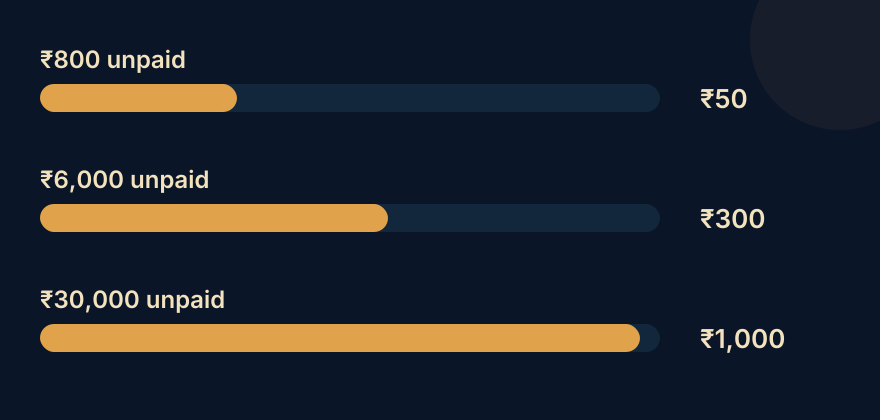
Those three amounts are arithmetic on the formula. They are not an example the bank printed. On ₹800 unpaid, 5 per cent is ₹40, so the fee before tax is the ₹50 floor. On ₹6,000, 5 per cent is ₹300. On ₹30,000, 5 per cent is ₹1,500, so the fee before tax is the ₹1,000 cap. The worked example in the secured-card agreement uses a different rate. Do not read it as the ZET charge from 23 October.
When the fee is charged
The secured-card agreement charges the fee if there has been no payment, or a payment below the minimum amount due, by the due date plus three days. It charges the fee on the outstanding amount. The separate ZET most-important-terms PDF says the same about the three days. Its table still shows ₹299 plus tax, and it does not mention 23 October.
The Reserve Bank’s directions for commercial banks, updated as on 1 October 2026, say a late-payment charge may be levied only when the account remains past due for more than three days. Days are counted from the due date on the statement. The charge is on the outstanding amount after the due date, not on the total amount due. If you have already paid part of the bill, the statement should show the base the bank used.
The minimum amount due on the key fact statement is 5 per cent of the outstanding or ₹100, whichever is greater, plus card fees, any overdue minimum, any amount over the limit, and any instalment that is due. Paying at least that minimum by the due date is what the bank’s wording treats as enough to avoid the late-payment fee. Interest is separate. The sheet says there is no interest-free period if the previous month was not paid in full. From the start of the billing cycle that period shall not exceed 45 days, and it can range up to 48 days once three days of grace are counted. After it, interest on card purchases is listed at 3.5 per cent a month, or 42 per cent a year. A cash withdrawal has no interest-free period on that sheet.
The cancellation line, and a closure question
From 23 October 2026, the key fact statement lists ₹499 plus goods and services tax if the card is cancelled within two years of activation. The secured-card agreement repeats that dated line, and it also still describes ₹499 within one year. The ZET most-important-terms PDF still prints ₹499 plus tax within the first year, and it does not mention 23 October.
Paragraph 23(7) of the Reserve Bank directions says a change in charges takes effect only for the future, after prior notice of at least one month. It also says that if you surrender the card because a change in charges is to your disadvantage, the issuer permits that closure without an extra charge for the closure, once the dues are paid. The key fact statement does not show the date a notice was sent. Your own message from the bank is that record. If you are closing because of this change, ask which line applies to your account, and keep the reply. This article does not decide that question.
Which copy to read
When the copies differ, start with the one that names 23 October, then read the statement on your account. The directions say the issuer gives you a key fact statement, and sends the most important terms again when a condition is modified, with notice. A calm way to read one sheet is in how to read your card’s benefits and the MITC.
If you hold this card, confirm the date, the 5 per cent, the ₹50 floor, the ₹1,000 cap, and whether tax is added. Find the minimum amount due and the due date on the current statement. If you pay only that minimum, read the interest line as well. The next statement is the record of what was billed.
Sources
Disclaimer
This article is for general information only. It is not financial, legal, or tax advice, and it is not a recommendation to apply for, keep, or close any card. Card benefits, fees, and terms are set by the issuer and the card network, and they change often. Verify them with your bank, and read your own Most Important Terms and Conditions, before you rely on them. Arthya is not affiliated with or endorsed by any bank or card network. All trademarks belong to their owners.