 Arthya
From 1 November, a PNB reward redemption is ₹99 a request
26 October 2026

On the credit card portal of Punjab National Bank, a banner says service charges on its credit cards change from 1 November 2026. The public notice sets six rows: the charge in force now, beside the charge from that date. The title says the figures are exclusive of applicable GST. This page was read on 26 October 2026. The notice does not print a publication date, or the day a message went to cardholders.
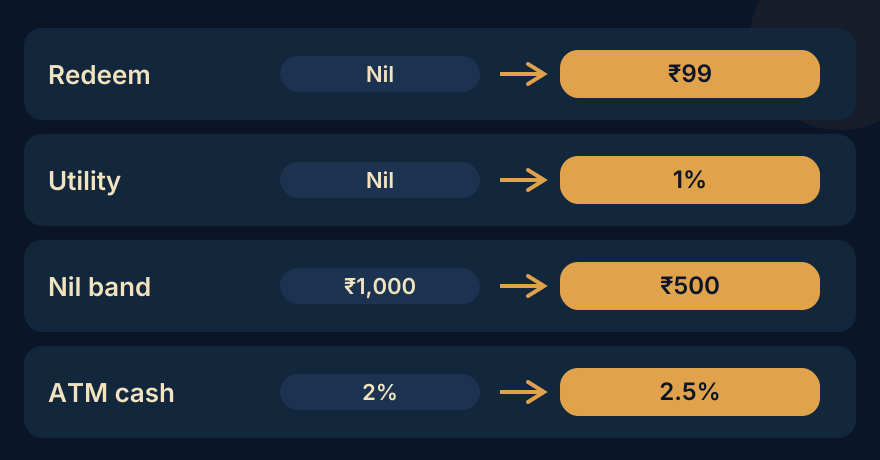
Two rows print nil in the existing column. For Visa and RuPay credit card variants, reward redemption becomes ₹99 per request, and utility payments pick up 1 per cent of their total once that total exceeds ₹50,000 in a billing cycle, capped at ₹2,000 per transaction. The other rows are cash advance, late payment, a returned cheque or a failed auto-debit, and a duplicate statement. The schedule does not set an earn rate, a point value, or a lounge visit.
The ₹99 is on the request
The notice dates the fee: nil in the existing column, and ₹99 per redemption request from 1 November 2026, for Visa and RuPay variants. The most important terms state ₹99 plus applicable GST for each redemption or claim. That sentence is not dated, and it does not repeat the variant list. Use the notice for the date and the variants, and the terms for the tax. If a statement already shows the fee, the statement is the record.
The same section says a redemption needs at least 1,000 points, made in writing, through the call centre named there, or on the credit card portal. Points expire if they are not redeemed within three years of accrual. Neither rule is one of the six modifications.
The fee is once per request. A block of 1,000 points and a larger block are each one fee, and a second request is a second fee. The point count inside a request does not change the ₹99. The schedule marks that figure exclusive of GST. The terms add “plus applicable GST”, and a note on the charge table says GST applies to fees, interest, and other charges.
Utility payments, after ₹50,000 in the cycle
The utility fee applies only once utility payments in a billing cycle exceed ₹50,000, at 1 per cent, with a maximum of ₹2,000 per transaction. At or under that total, the existing column stays nil. The cycle is the one on the statement. The notice does not name the merchant categories that count as utilities, so the statement line is the record.
Late payment, then cash
Late payment follows the outstanding total amount due. Now, ₹1,000 or less is nil, ₹1,001 to ₹5,000 is ₹500, ₹5,001 to ₹10,000 is ₹600, and above ₹10,000 is ₹750.
From 1 November, for Visa and RuPay variants, ₹500 or less is nil, ₹501 to ₹1,000 is ₹500, ₹1,001 to ₹10,000 is ₹750, ₹10,000 to ₹50,000 is ₹1,000, and above ₹50,000 is ₹1,200. A total due of ₹600 is nil on the existing scale and ₹500 on the revised one. ₹10,000 sits in both the ₹750 band and the ₹1,000 band. The terms, in the block marked effective from 1 November 2026, print the next band as ₹10,001 to ₹50,000 at ₹1,000. Where the copies differ, read both PDFs, then the statement.
A card against a fixed deposit keeps, in both columns, 30 per cent of the minimum amount due, from ₹200 to ₹500 a cycle. A Luxura card issued against a fixed deposit follows the ordinary Luxura charges.
The terms charge the fee if clear funds for at least the minimum amount due are not in the account by the due date, and they levy it on the outstanding amount after payments already received, not on the total outstanding. The Reserve Bank directions, updated as on 1 October 2026, allow that charge only after the account has stayed past due for more than three days, counted from the due date, and only on the outstanding amount after the due date. This article does not choose between those two wordings.
Cash advance on Visa and RuPay variants becomes 2.5 per cent of the cash withdrawn, or a floor, whichever is higher: ₹400 at a PNB ATM, and ₹500 at another domestic ATM or overseas. The existing column is 2 per cent, with a lower floor that changes by card and by ATM. The terms still say corporate and commercial cards cannot withdraw cash. The existing column also marks some cards, including Svanidhi, as having no cash withdrawal, and the revised column does not repeat that mark.
A returned cheque, a dishonoured ECS, or a failed auto-debit becomes 2 per cent of the payment, minimum ₹400, on Visa and RuPay variants. A card against a fixed deposit stays at ₹100 an instrument. A duplicate paper statement beyond three months is ₹50 a month. An e-statement has no charge, and the terms also waive that fee on a fixed-deposit card.
Before the date on the notice
The notice names 1 November and does not show when a cardholder was told. The terms require at least one month’s intimation before a charge changes. Paragraph 23(7) of the Reserve Bank directions says the change is prospective, after prior notice of at least one month, and that a cardholder who surrenders the card because a change is to their disadvantage may close it without an extra closure charge, once the dues are paid. Keep the message you received. One dated fee line is set out in the ZET late-payment article, and a full sheet in how to read the MITC.
Match the card to the words Visa and RuPay. Count each redemption as one request, see whether utility payments cross ₹50,000 in the cycle, and place the total amount due on the late-payment bands. The next statement is what was billed. This page does not promise that a fee will appear, or that it will not.
Sources
Disclaimer
This article is for general information only. It is not financial, legal, or tax advice, and it is not a recommendation to apply for, keep, or close any card. Card benefits, fees, and terms are set by the issuer and the card network, and they change often. Verify them with your bank, and read your own Most Important Terms and Conditions, before you rely on them. Arthya is not affiliated with or endorsed by any bank or card network. All trademarks belong to their owners.